Three-Part Garden Tour Starts on May 30
This summer Wild Ones Capital Region NY offers a three-part view into Sacred Soil Gardens, hosted by Genoveffa V., a longtime Capital Region Wild Ones member and the chapter’s vice president. This trilogy of garden tours gives members a view of the garden over the growing season from late spring to midsummer and early fall.
Saturday, May 30: Gen will be on hand to share her expansive garden of native trees, perennials and vegetable plants. She’ll also demonstrate the “Chelsea chop” pruning technique. This event is members-only but each member is welcome to bring one guest. Rain date is May 31. Register here to attend.
Thursday, August 6: Part 2 – See what the garden is like in the peak of summer. Register here to attend.
Check back for future dates.
Here’s how Gen describes her gardening journey:
I grew up in a very traditional Sicilian family where we ate mostly what we grew all year round. As a child, I was more interested in the naturally occurring plants and insects that I could observe on our 13-acre farm. In my early adult years, I started working my summers at an organic flower and vegetable farm, Nine Mile Farm, under Rebekah Rice. She is a proponent of permaculture and began to instill in me a basic understanding of how our actions impact our local ecosystems.
I began to garden a bit on the property line and added flowers here and there. I added some fruit trees at one point and one of them surprisingly died. I replanted it the next year and it died again. Through a deep dive, I discovered that the black walnut trees growing on my property’s edge were likely the cause of their demise. This led to a rabbit hole of discovery to find black walnut resistant plants. Eventually, I fully replanted the entire length of the edge of my property with perennials and shrubs.
I’m not one to do well sitting still and I need strong interests or projects to be happy. So, when Covid stopped everything in my life, I turned to gardening to fill it – and boy, did it! I added more perennial beds and learned about gardening techniques – eventually delving into soil health through regenerative practices. I built three vegetable gardens and created a grow room in my basement. Regenerative gardening became an obsession and I’ve been riding the wave ever since. Eventually, I learned the full scope of importance that native plants have on our local ecology. I stopped buying from big box stores and started researching local native plant nurseries. I have not replaced all the non-native plants in my perennial beds, but I’m not doing anything to stop the wildlife from eating them. Eventually I hope to have a majority of native perennial plants growing on my property.
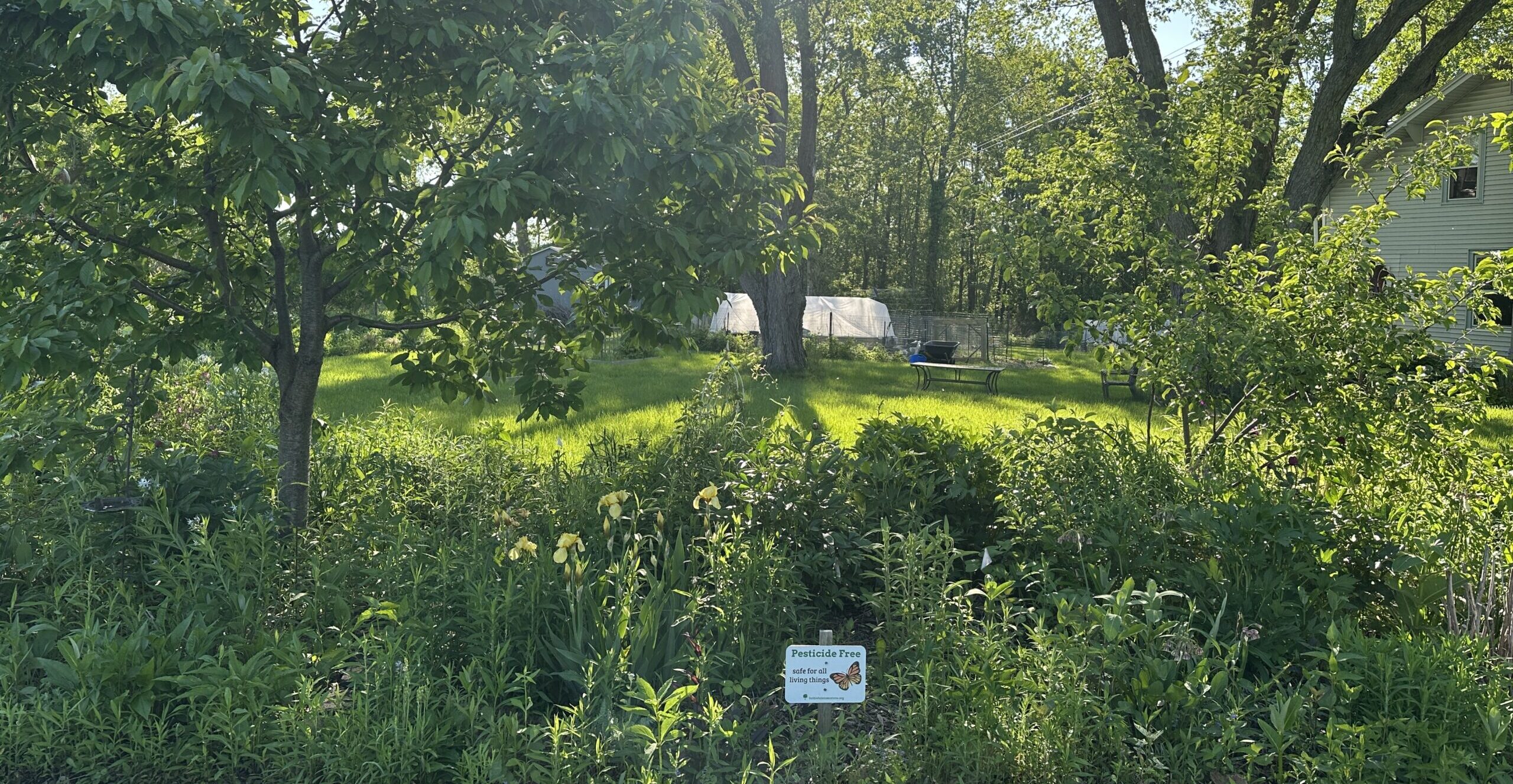
I live in a rural community with houses that are just close enough to have neighbors, but far enough where we don’t see into each other’s windows. When you walk in from the street, you will first see the street-line garden with three different sun zones and soil types. It spans most of the street line and provides a little bit of privacy to the back.
When you walk in, you will see another perennial garden lining the southern edge of the property with overgrown goldenrods, Joe Pye weed, asters, elderberry, jewelweed, obedient plant, spicebush and evening primrose. The southern border previously had a thicket of invasive Japanese honeysuckle behind it that my neighbor removed last winter. The forsythia is a placeholder for future miniature pin oaks, service berries, pagoda dogwood, and other native food forest options.
Behind the house, beyond the two large silver maple trees, are the two fenced off vegetable gardens and cut flower beds. The western wood line has black walnut, ash, maples, and a snag covered in grapes and poison ivy that provide food and habitat for the local wildlife. My new neighbor who owns the wooded area is an Agroforester and our plans are to remove the invasive species in the back woods in the coming year or two. There is a thicket of wild black raspberries and a bed of goldenrod and New England aster–with some turtle head and blue flag iris sprinkled in.
The driveway is the last vegetable garden with tomatoes and huckleberries. The plan for the years to come is to plant some huckleberry bushes and native grasses on the northern slope of the property.
This property was all lawn when I moved here in 2016. The only gardens were small patches surrounding the house perimeter and the side of the garage. Everything along the property edge was an invasive honeysuckle thicket. The soil has various areas spanning from loam, to sand, to heavy clay. It has been amended with compost and wood chips, but that was only for the first two years of establishment. Ever since I use the chop and drop method, using the old plant matter from the previous year as mulch. The water table is very high in this area, so drought is possible, but not as detrimental as other landscapes. The soil is alkaline, but with proper soil management and biodiversity, plants can grow just fine.
The north property line and back woodline gardens were begun in 2019, the street line garden was added in 2020, and the vegetable gardens were added in 2021 (modified to raised beds in 2023).
Every year brings new plans and experiments. I utilized a great deal of the Chelsea chop to sculpt the perennial beds into layered levels. I made my own bioinoculants to feed my veggies and help with plant health. I’ve also experimented with growing mushrooms and using mushroom compost in the veggie beds. The garden’s future is promised to more native fruit trees. I hope to provide food to birds and animals in the colder months (and share a wee bit in the spoils). The goal is to have barely any lawn left in the next 5 years. I just might be on my way.
My favorite part about joining Wild Ones is that I have had the opportunity to meet some pretty wonderful, like-minded individuals. I truly look forward to chatting and sharing experiences with tour attendees.